
Why we stopped at 1,800 Kelvin
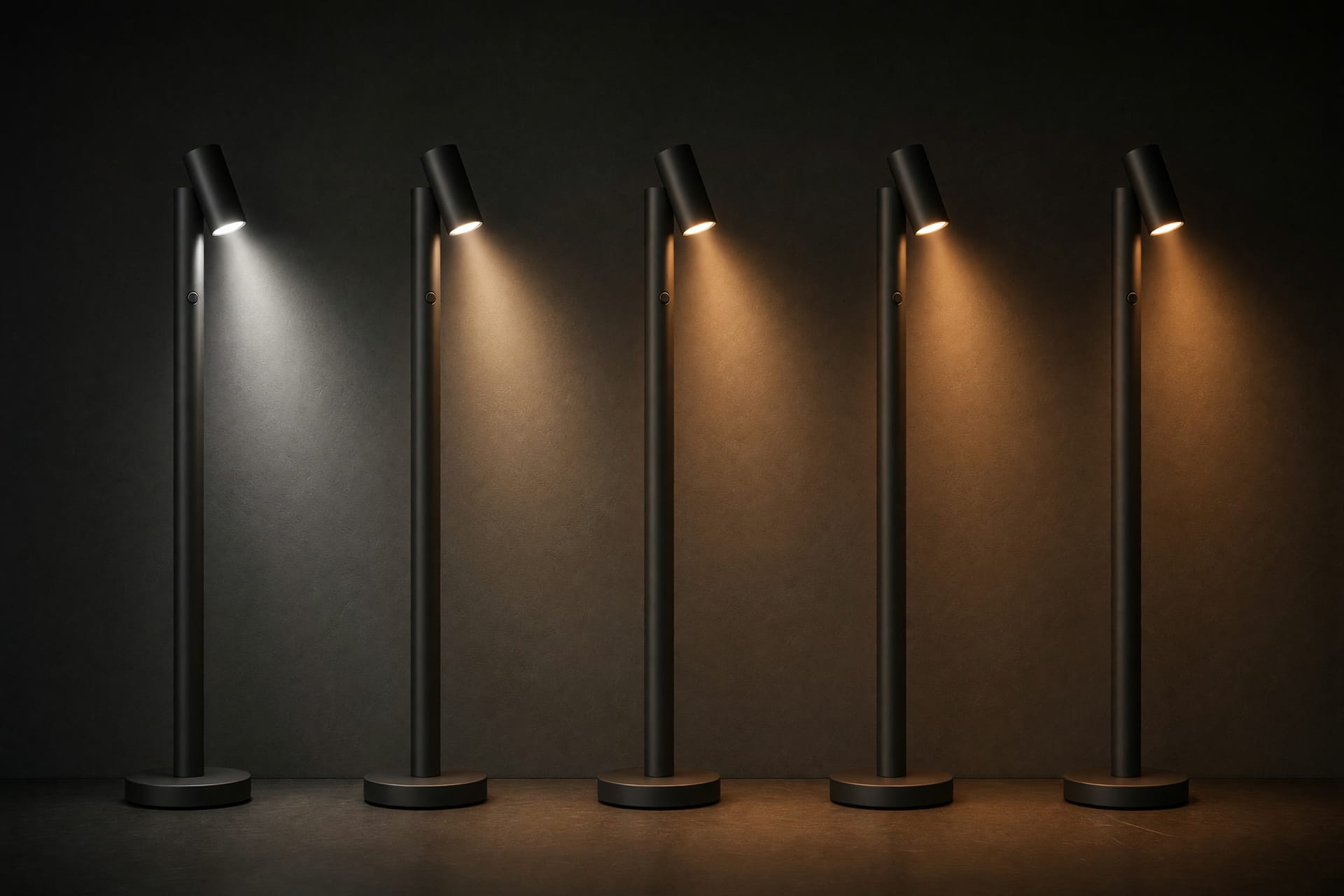
We could have gone lower. That is worth saying first, because 1,800 has the shape of a number someone chose for how it looks on a page.
Candlelight sits around 1,850 Kelvin. A wood fire is lower and wanders. There are lamps advertising 1,000 K, and there is nothing stopping anyone building one — the emitters exist, the driver is not hard, and the marketing writes itself. We built one, in fact, fairly early, and it is on a shelf.
What happens on the way down
Color rendering collapses before anything else does, and it collapses unevenly, which is what makes it hard to notice until it is too late.
Reds hold. They hold almost all the way down, which is the trap — the first thing you check is usually something warm, a wooden desk or your own hand, and both look wonderful. Then you look at anything green or blue. A plant goes grey-brown. A blue book cover goes black. A room lit at 1,200 K is not a warm room; it is very close to a monochrome one, and it takes about a week of living in it before the eye stops filling in the colors it expects and starts noticing the ones that are missing.
The trade is direct and it does not have an escape. Every degree of warmth costs a degree of accuracy, because the further the spectrum is pushed toward the red end the less there is left of everything else. Anyone selling both perfect warmth and perfect rendering at the bottom of a range is selling one of them on trust.
Where the line actually is
1,800 K is where we can still hold 97 CRI with the emitters available to us. That is the entire derivation. Not a taste decision, not a study, not a threshold anyone found in the literature — the point at which the number we refuse to give up stops being achievable.
Below it, something has to give, and what gives is the part nobody notices until their books look brown. We would rather stop at a floor that is slightly higher than candlelight and have every color in the room survive the trip down than advertise a lower figure and quietly ship a monochrome evening.
The honest part
If better emitters arrive, the floor moves.
This is a manufacturing limit, not a philosophy. We have caught ourselves describing 1,800 as though it were a considered position about human circadian rhythm, and it is not — it is the number the parts bin allows while holding the other number we care about. If a supplier solves deep-red rendering at 1,600 next year, the curve will go to 1,600 and this post will be edited.
And that is it
An unusual amount of argument went into one figure on a spec sheet that most people will never read. We are aware of this. It took four months and there were two of us on opposite sides of it for most of that, and the result is a number three digits long.