A room lit from the side
You have been in this room. One fixture, dead center of the ceiling, probably four bulbs behind something frosted. It is not dim. That is the confusing part — there is plenty of light, the room is perfectly usable, and it still feels like a corridor you are waiting in rather than a room you are in.
People describe it as harsh, which is not quite it. Harsh would be a bare bulb. This is something flatter and harder to name: a room where nothing has a front or a back, where the sofa and the wall behind it seem to occupy the same plane, and where anyone standing under it looks slightly unwell without being able to say why.
What overhead light actually does
Light from directly above puts a shadow under every horizontal surface. Under the shelf, under the table edge, under the arm of the chair — and, on a face, under the brow, the nose and the chin. Those are the three shadows a person reads first, and putting all of them in the same downward direction is the reason overhead light is unkind to faces. It is the same effect as a torch under the chin, run in reverse and with better manners.
The flattening has a simpler cause than the unkindness. Depth in a scene comes from the angle between the light and your eye. Directly overhead, on a person standing at your own height, that angle is nearly zero — the lit sides and the shadowed sides fall almost exactly where your line of sight cannot see them. So you get illumination without modelling. Everything is visible and nothing is described.
What side light does instead
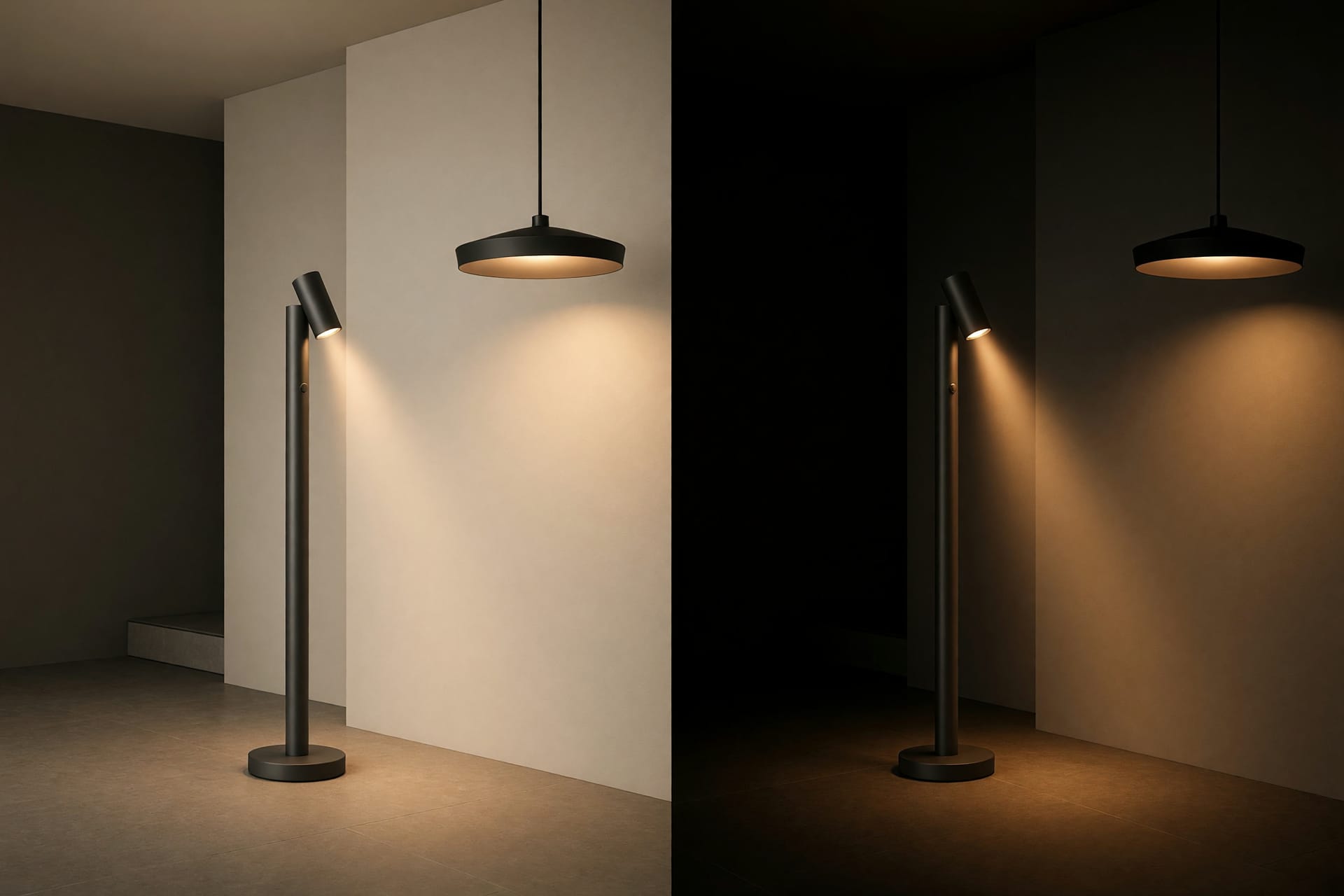
Move the source down and around and the geometry changes completely. Now one side of every object is lit and the other is not, and the boundary between them tells you the object's shape. A wall picks up a gradient instead of a wash. A face acquires a lit side and a shadowed side, and reads as solid rather than as a photograph of itself.
This is not an aesthetic preference. It is the whole basis of stage lighting and has been for a century. A conventional rig gives a body a key from one side, a softer fill from the other, and something separating it from what is behind — and an audience forty meters away reads a three-dimensional person out of that arrangement without ever being conscious of it. Take the key away and put a single source overhead, and the same actor becomes a cardboard cutout in the same costume.
The domestic version is the same physics with worse hardware.
Why almost nobody does this at home
Because the wiring is in the ceiling. The socket is where the builder put it, the fixture came with the flat, and taking it down is a conversation with an electrician and possibly a landlord.
A lamp, by contrast, is an object you have to want, choose, buy, carry home, find a surface for, and run a cable to. It is a decision, and the ceiling light is not a decision — it is a default that was made for you before you arrived, by someone optimising for a certificate rather than for an evening.
So a hundred years of well-understood craft sits on the wrong side of a small activation cost, and everybody lives under a photocopier.
The point of all this
The fixture is not going anywhere. Most people cannot remove it and a good number are not allowed to try.
But it does not have to be the only thing on. One source, lower down and off to the side, changes a room more than any amount of adding brightness to the middle of the ceiling — and unlike the ceiling, it is a thing you can put on a table this evening.